In short
- Why the accounts are not enough to show the value of a museum or a foundation
- The four pillars of sustainability, including the cultural one
- What a sustainability report contains and how it feeds the case for support
The accounts are not enough
The annual accounts of a museum or a foundation show how much comes in and how much goes out. They do not show how many schools came through the galleries, which communities recognised themselves in an exhibition, or which heritage was saved or made accessible.
Yet it is precisely this value that justifies the support of public bodies, foundations, companies and citizens. Cultural organisations must be able to express their role as agents of social, cultural and environmental sustainability: this is how they secure the resources for long-term economic sustainability.
The sustainability report is the tool for doing this in an orderly and credible way.
What sustainability means
The word comes from the Latin sustineo, which means to support, but also to protect, to endure, to nourish, to resist. Sustainable is what can carry on over time. One question remains, though: carry on for whom, and at whose expense?
The most quoted answer is the one in the 1987 Brundtland Report: sustainable development is development that meets the needs of the present without compromising the ability of future generations to meet their own needs. From this come the three classic pillars: environmental, social and economic.
In 2001 Jon Hawkes proposed adding a fourth one, cultural vitality, considered as essential to a healthy society as social equity, environmental responsibility and economic viability (Hawkes, The Fourth Pillar of Sustainability). In 2010 the world network of cities, UCLG, also recognised culture as a pillar of sustainable development.
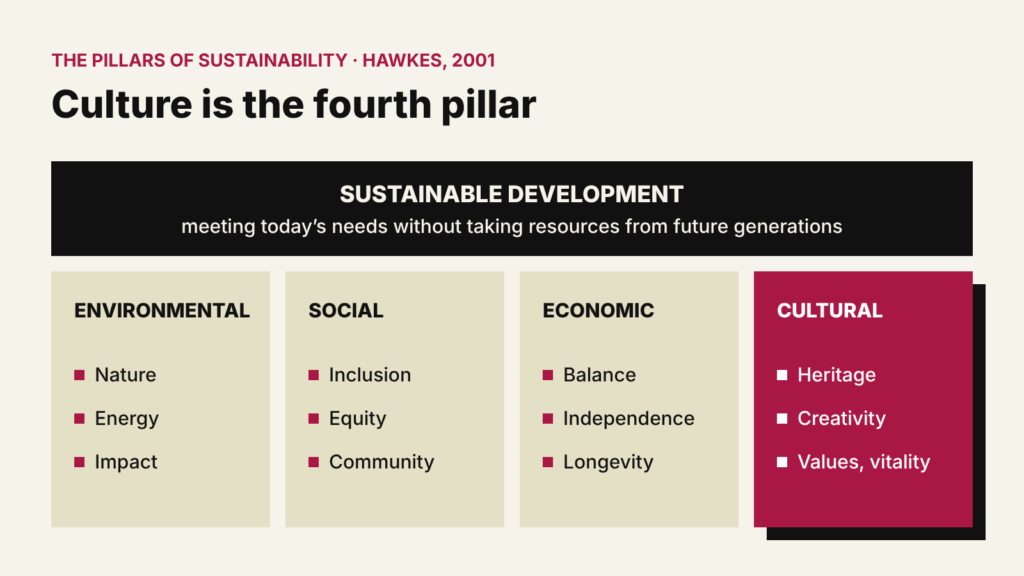
For a cultural organisation the fourth pillar is not an add-on: it is the very reason it exists.
Cultural sustainability and sustainable culture
For a museum or a foundation sustainability has two sides, which need to be held together.
- Cultural sustainability: the contribution the organisation makes to society. Preserving and presenting tangible and intangible heritage, supporting artistic production, safeguarding the knowledge and skills of communities and places.
- Sustainable culture: the organisation’s ability to sustain its own existence and growth, while respecting and supporting the other three pillars.
The second condition makes the first possible: without stable resources, no cultural mission lasts over time.
The four conditions of economic sustainability
- Institutional balance: governance that balances powers, controls and responsibilities.
- Independence: the freedom to set your own objectives without excessive outside pressure.
- Longevity: the ability to operate over the long term, even when the context and the people change.
- Economic viability: the ability to attract and mobilise the resources needed, without depending permanently on outside support.
In the cultural sector the last one is the most fragile. Costs are largely fixed, income is often weighted towards public grants, and willingness to pay depends on economic, cultural and access barriers. This is why diversifying sources of income is decisive, and to diversify them you need to be able to demonstrate your value.
What a sustainability report is, and who has to produce one
It is a document, usually annual, that reports on an organisation’s results across all the dimensions of sustainability: not only economic, but also social, cultural and environmental. It may be called a social report, a mission report or a sustainability report: the emphasis changes, the purpose is the same.
In Italy it is compulsory for some organisations. The Third Sector Code and the guidelines in the ministerial decree of 4 July 2019 require it from Third Sector organisations with income above €1 million, from volunteer service centres and from social enterprises (Ministry of Labour, Decree of 4 July 2019). It must be filed with the national Third Sector register (RUNTS) and published on the organisation’s website.
For everyone else it is a choice. But it is an increasingly common one: museums, foundations and cultural enterprises produce it because they want to make their impact visible to funders, partners and communities.
What a sustainability report contains
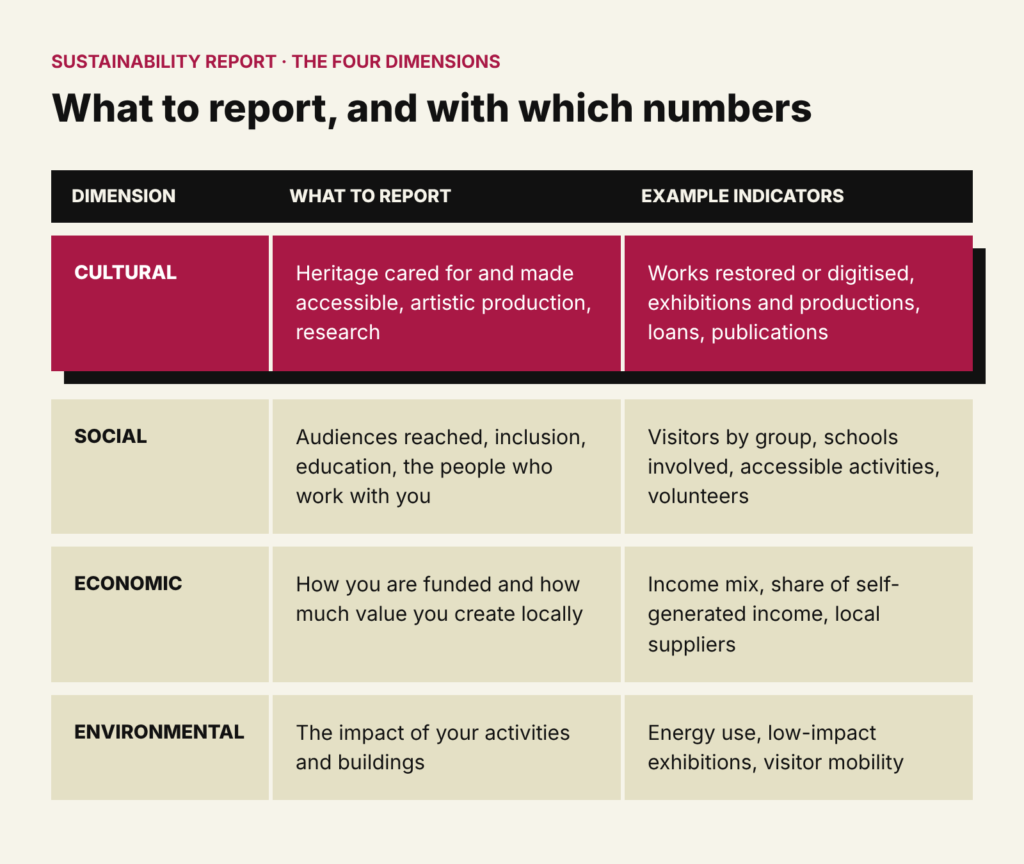
Our advice is not to try to report on everything. The topics to explore in depth are chosen by the materiality matrix: they are the ones that really matter to you and to your stakeholders. For each one a few indicators are enough, followed over time, with clear objectives for the following year.
From the report to the case for support: informing and persuading
The sustainability report informs: it says in an orderly and verifiable way who you are and what you have achieved. To raise resources, however, you also need to persuade. That is the job of the case for support, the document that explains why someone should support you.
A case for support answers five questions:
- Why you exist: mission, vision, objectives and values.
- What problem you want to tackle, and why it is urgent right now.
- What you do to solve it: an activity you already carry out and want to strengthen, or a new project.
- Why you are the right people to do it: history, expertise, collections, local roots.
- How the reader can help you: with a donation, a membership, a legacy, volunteering or by spreading the word about the cause.
The two documents feed each other. The report provides the data and results that make the case for support credible. The case for support turns those results into a story and a precise request. Together, they allow a cultural organisation to present itself as an agent of sustainability, and so to obtain the resources to keep being one.
How we work
At Museum Strategy Consultancy we support museums, foundations and non-profit organisations throughout the process: we choose with you the topics to report on, define measurable indicators, collect the data and write a sustainability report that is readable, not a list of numbers. When needed, we turn it into a case for support for fundraising.
Do you want to tell the story of the value you create? Write to us or discover our Reporting service.
Sources
- World Commission on Environment and Development, Our Common Future (the Brundtland Report), 1987
- Jon Hawkes, The Fourth Pillar of Sustainability: Culture’s Essential Role in Public Planning, 2001
- Dessein et al. (eds.), Culture in, for and as Sustainable Development, COST Action IS1007, 2015
- Italian Ministry of Labour, organisations required to publish a social report (in Italian)
- Ministerial Decree of 4 July 2019, Guidelines for the social report of Third Sector organisations (in Italian)