In short
- What a case for support is, and what it is not
- The five questions it answers, with examples for a civic museum
- How to build one, the mistakes to avoid and how it feeds every fundraising material
Explain before you ask
Nobody supports an organisation that cannot explain why it deserves to be supported. This is true for a private donor, for a company considering a sponsorship, for a foundation reading a project proposal.
To raise funds, but also to position themselves, cultural organisations must be able to communicate the strength of their mission, the contribution they make to the community and the value of taking part in a clear vision. In other words, they need to make explicit their role as agents of social and cultural sustainability, to secure the conditions for long-term economic sustainability.
The case for support is the tool that sets out these reasons in order.
What it is, and what it is not
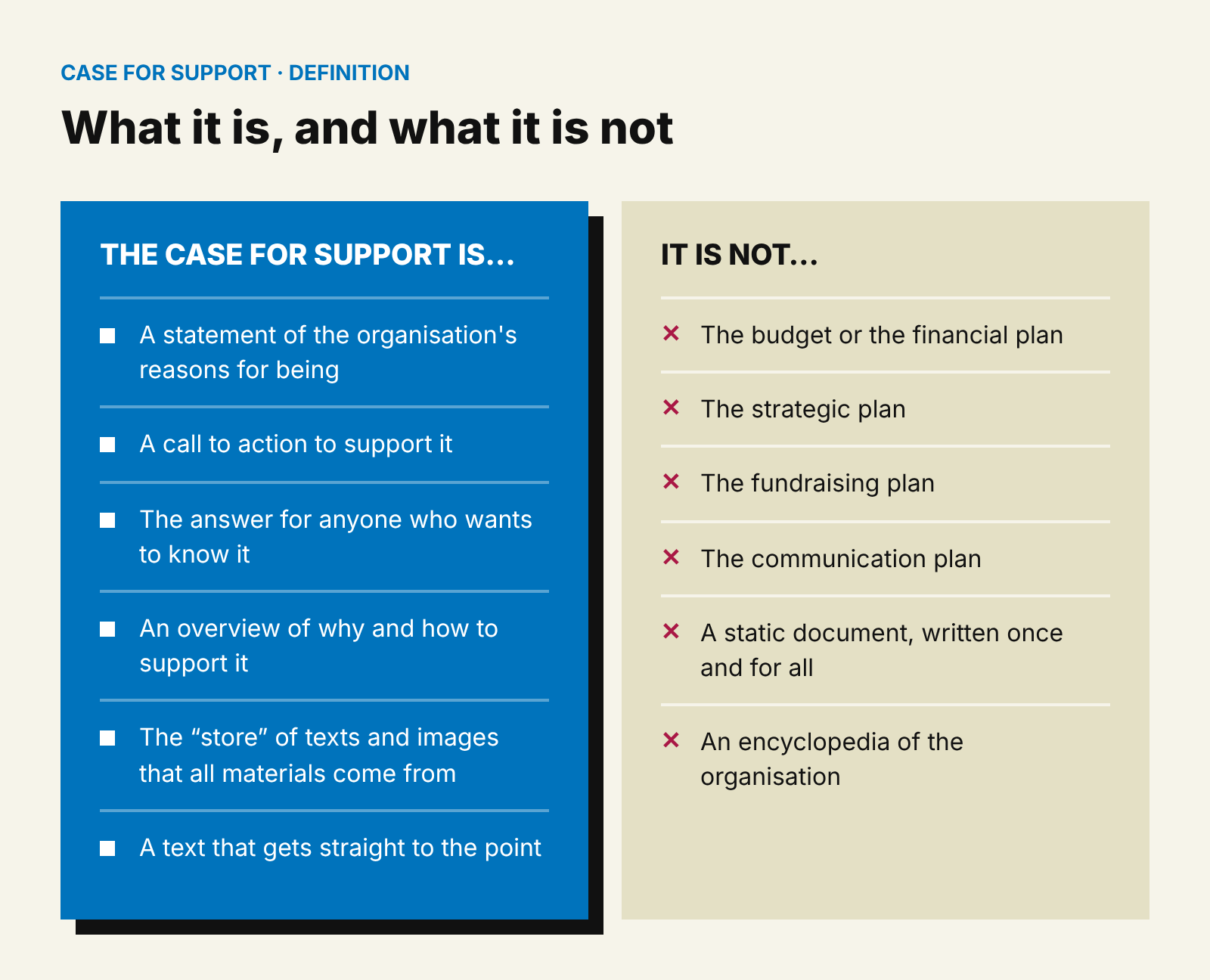
The case for support sets out the organisation’s vision for the future and invites others to share it. It does not replace your plans: it feeds them, giving everyone the same underlying reasons.
Informing and persuading
A case for support does two things at once.
- It informs. It describes precisely what the organisation is and what it does, and highlights what makes it important, necessary and relevant to its community and its stakeholders.
- It persuades. It sets out clearly the reasons why the reader should support it, and makes explicit the conditions of integrity and need that lead it to ask for help.
A text that informs without persuading remains a brochure. One that persuades without informing sounds like an unconvincing request. You need a balance between the two.
The five questions it answers
Every case for support follows the same outline. Next to each question, an example answer for an imaginary civic museum.
- Why do you exist and who do you work for? Mission, vision, objectives and values. The mission is the concrete purpose, the what and the how; the vision is the ambition, the why, the mark you want to leave on your community. Example: “We look after the history of the city so that every citizen can recognise themselves in their own past.”
- What need do you want to address? The problem that prevents you from achieving your vision, and why it is urgent right now. It can be presented as a threat (“if we do not act now…”), an opportunity (“imagine what we could do…”) or a responsibility (“the choice to change is ours”). Example: “Half of the city’s young people have never set foot in the museum.” The data in your sustainability report are the basis for this answer.
- What do you want to achieve, and why now? The solution: an activity you already carry out and want to do better or more of, or a new project. Example: “A programme of free workshops with every middle school.”
- What will change thanks to the support received? The expected impact, described in concrete and, where possible, measurable terms. Example: “In three years, every student in the city will have visited the museum at least once.”
- Why you, and why the donor? The history, expertise, collections and local roots that make you the right organisation. And the ways the reader can take part: financial support (a donation, a membership, a legacy), volunteering, advocacy. Example: “We are the only place that holds the city’s historical archive. With €50 a young person can take part in a whole workshop.”
How to build a case for support
- Gather and organise the information. History, institutional profile, context, activities. A map of past, present and future activities helps, together with the documents in which the mission and vision are already written.
- Carry out an honest analysis. Strengths and weaknesses, the cultural and economic features of the organisation.
- Write the outline. An engaging opening with mission and vision, then the five answers, in order. One or two pages per section are enough.
- Reread it through the donor’s eyes. Every sentence should help them decide. Whatever does not help to persuade can go.
The mistakes to avoid
- Writing too much, or too little. Give the information needed and get to the point: flooding the reader is as ineffective as leaving them without the information they need.
- Confusing it with a plan. Budget, strategy and the timetable of actions have their own documents.
- Talking only about yourselves. At the centre is the need you want to address, not the organisation.
- Forgetting the ask. Without a clear call to action, even the best text will not bring in support.
- Never updating it. The case for support changes with your projects and with the results achieved.
One story, many materials
The case for support is not sent out as it is. It is the store from which you take texts, data and images for all your fundraising materials. In this way each audience receives a message that differs in form but is consistent in substance.
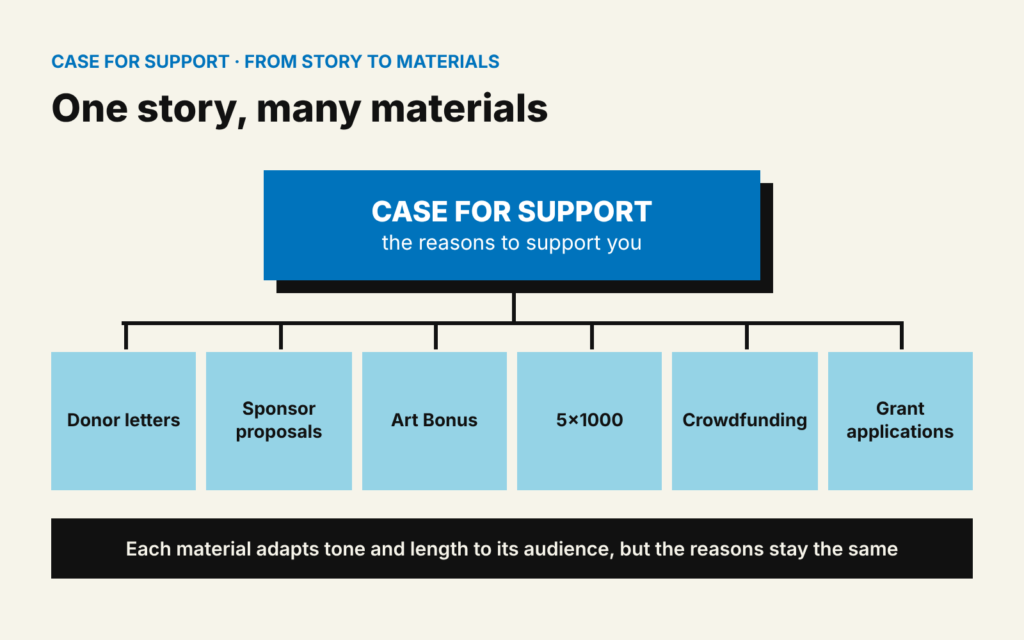
A letter to a private donor will focus on emotion and impact. A proposal to a company on the topics it shares with you. A grant application on requirements and measurable results. The underlying reasons, however, stay the same.
How we work
At Museum Strategy Consultancy the case for support is the first step of every fundraising process. We build it with your team, starting from the analysis data, and turn it into materials for every audience: letters, sponsor proposals, Art Bonus and 5×1000 campaigns (the Italian tax incentives for giving to culture and to non-profits), crowdfunding and grant applications.
Do you want to find out whether your organisation is ready to raise funds? Discover Traccia and Faro or write to us.
Sources
- Irene Popoli, Stakeholders Engagement and Fundraising: A Strategic Tool for Business-Oriented Sustainability, MaBAC seminar, Ca’ Foscari University of Venice – ESCP, 2025
- Irene Popoli, Il case for support, fundraising course materials (in Italian)
- Inspiring Fundraising, Writing a case for support
- CCS Fundraising, Writing a compelling case for support
- Arts Professional, Building a stronger case for support