In short
How the materiality matrix helps museums and foundations decide where to focus resources, projects and communication: what it is, the four dimensions of sustainability, how to build one in five steps and the mistakes to avoid.
Why ask what really matters
Every cultural organisation does more things than it can do well. A civic museum, for example, looks after its collections, educates, welcomes schools and tourists, puts on exhibitions and works with the local community. A foundation designs and develops projects, manages an endowment, and is accountable to its governing bodies and to those who fund it.
Resources, on the other hand, are always limited – and often shaped by external factors: people, time, budget. This forces organisations to prioritise some activities over others, choosing where to focus while knowing that internal priorities do not always match what visitors, communities, public bodies and supporters expect.
This is exactly what the materiality matrix is for: putting the two perspectives on the same page and seeing where they meet.
What a materiality matrix is
It is a chart with two axes.
One measures how much a topic matters to the organisation, that is, how much it affects its mission and the impact it creates. The other measures how much it matters to stakeholders: audiences, communities, public bodies, partners, funders, staff.
Each topic is placed on the basis of data and listening, not impressions. The topics in the top right corner are the material ones: they matter to both sides and deserve resources, objectives and reporting.
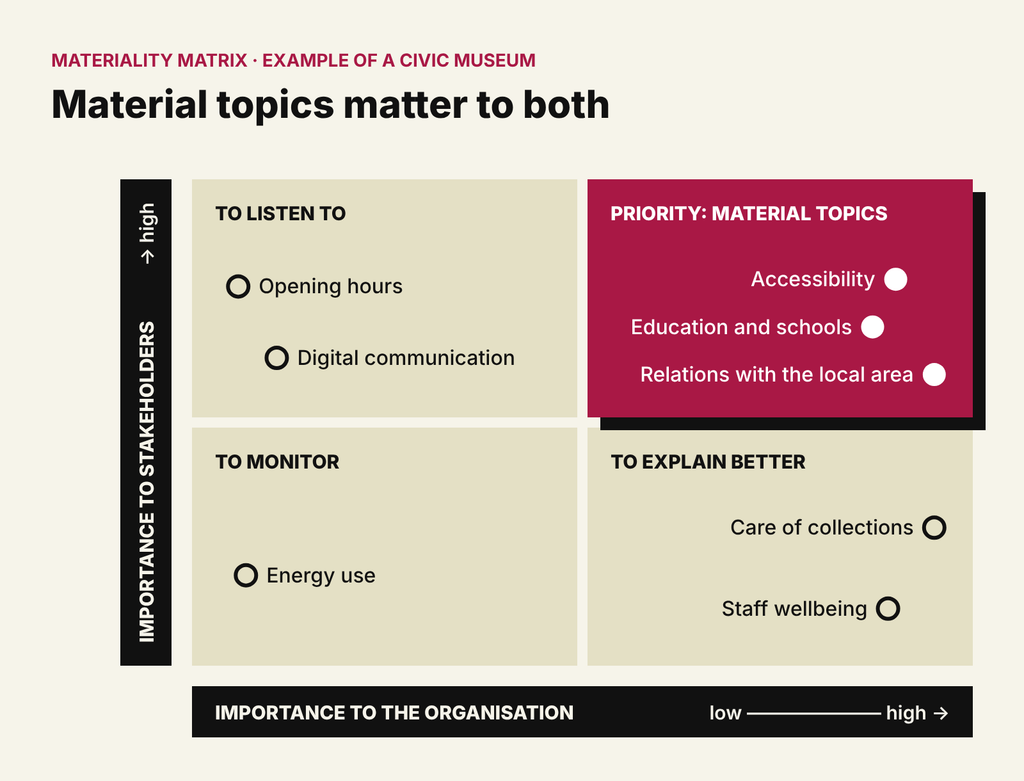
The positions are only an example: in a real museum they are set by internal analysis and dialogue with stakeholders. The other quadrants still tell you something: a topic that matters to the public but is neglected internally needs to be heard; one you invest heavily in but nobody sees needs to be explained better.
Which topics: the four dimensions of sustainability
Companies build their matrix on the three classic pillars of sustainability: environmental, social and economic. A cultural organisation needs a fourth one, the cultural pillar, which the scholar Jon Hawkes proposed as early as 2001 as a dimension just as essential as the others.
A good list of topics therefore includes all four kinds:
- Cultural: care and accessibility of collections, artistic production, research, safeguarding local knowledge.
- Social: education, inclusion, community participation, the wellbeing of the people who work with you.
- Economic: diversification of income, independence, benefits for the local area.
- Environmental: energy use, the impact of exhibitions and events, visitor mobility.
In this way the matrix holds together the two sides of a cultural organisation’s sustainability: what it gives to society and its ability to last over time.
Materiality and double materiality, in plain words
The concept comes from sustainability reporting. The international GRI Standards define as material the topics that represent an organisation’s most significant impacts on the economy, the environment and people (GRI 3: Material Topics 2021).
European legislation on companies (CSRD) adds a second lens, double materiality: what counts is the organisation’s impact on the world, but also the effect that sustainability topics have on its finances and its continuity. The Omnibus I directive, in force since 18 March 2026, has narrowed the obligation to companies with more than 1,000 employees and over €450 million in turnover (CMS). Double materiality, however, remains at the heart of the method (Generation Impact).
For a museum or a cultural foundation this means two things. Almost none are required to follow the CSRD, so the method can be adapted to your size. But the companies that support you, sponsors and partners, increasingly think in these terms: speaking the same language helps.
Why it is useful for a museum or a foundation too
In the cultural sector the matrix is no longer a rarity: CoopCulture and Associazione Civita, for example, publish it in their sustainability reports (CoopCulture, Civita). But its value goes beyond the final document. In our work we use it in three ways.
- Strategy. It shows where to focus resources and projects over the coming years, and what can be scaled back or postponed.
- Social and sustainability report. It decides what to report on in the sustainability report and with which indicators, avoiding long documents that talk about everything.
- Fundraising. It shows foundations, public bodies and companies that your priorities come from listening. For a sponsor, finding its own topics in the top right corner of your matrix is a good starting point for a partnership. And material topics are the basis of your case for support, the document that explains to supporters why they should back you.
How to build a materiality matrix in five steps
- List the topics. Start from the mission, the strategic documents and the context. In a civic museum the list might include accessibility, education, care of collections, relations with the local area, staff wellbeing, energy use. Better 12–15 clear topics than 40 generic ones.
- Map the stakeholders. Who influences the organisation and who is affected by it: visitors, schools, the local community, the administration, partners, supporters, staff and volunteers.
- Listen. Questionnaires, interviews, focus groups, visitor and satisfaction data. Each group indicates how much the different topics matter to them.
- Assess the internal impact. Management and staff estimate how much each topic affects the mission and results, with shared criteria and, where possible, with data.
- Position and decide. The scores become the matrix. The decisive step comes afterwards: for each material topic you set objectives, people responsible and indicators to monitor over time.
For a medium-sized organisation the process usually takes a few weeks. The matrix should then be updated regularly, for example every two or three years or when the strategy changes.

CASE STUDY · FONDAZIONE ARNALDO POMODORO
From the materiality matrix to partnerships with FENDI and Tenute Lunelli
For the Fondazione Arnaldo Pomodoro the matrix was the starting point: it set objectives and priorities for each category of stakeholder and guided the case for support, the partnership kits and the new corporate membership programme.
Materiality matrix: the mistakes to avoid
- Doing it behind a desk. A matrix built only by management confirms what was already thought. Without listening to stakeholders it loses its meaning.
- Putting everything in the top right corner. If every topic is a priority, none is. The matrix is there to help you choose.
- Topics that are too vague. “Culture” or “sustainability” do not help you decide. “Accessibility for people with sensory disabilities” does.
- Stopping at the chart. A matrix without objectives and indicators remains a picture in the social report. Its value lies in the decisions that follow.
- Never updating it. Audiences, places and funders change. A matrix from five years ago describes a different organisation.
How we work
At Museum Strategy Consultancy the materiality analysis is often the first step of a broader process. We design stakeholder engagement, collect and read the data with our analysis tools, and build the matrix together with your team. Then we turn it into strategic priorities, indicators for the social report and arguments for fundraising.
Do you want to understand which topics really matter to your organisation? Write to us or discover our Analysis service.
Sources
- GRI 3: Material Topics 2021
- CMS, ESG News: Omnibus I reduces thresholds and obligations for companies from 18 March (in Italian)
- Generation Impact, Omnibus I explained: what changed for double materiality
- CoopCulture, Sustainability report (in Italian)
- Associazione Civita, Sustainability report (in Italian)
- Jon Hawkes, The Fourth Pillar of Sustainability: Culture’s Essential Role in Public Planning, 2001
Downloads
PDFCoopCulture, Sustainability report (in Italian)DOWNLOAD ↓ PDFAssociazione Civita, Sustainability report (in Italian)DOWNLOAD ↓